

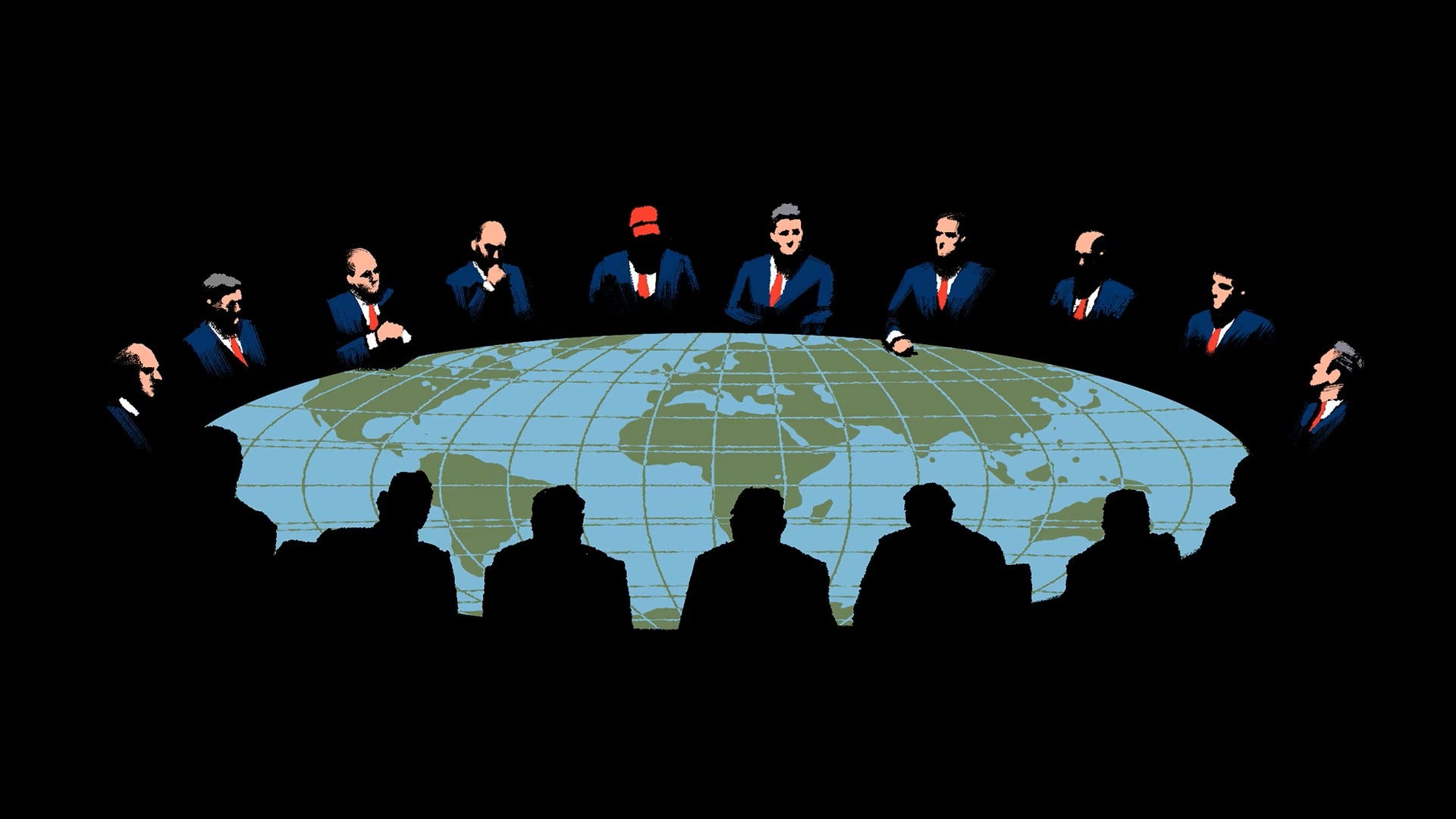
Think about this:
In Greenland, American businessmen with murky links to the Trump administration are proposing implausible projects, seeking allies and trying to influence public debate. Their goals appear to be both commerical and political: pull Greenland into the American spehre of influence and make money at the same time.
In Canada, American tariffs are targeting Canada’s economy while at the same time American diplomats and officials quietly promote a separatist movement in Alberta. It’s unlikely to succeed. But if it did, it could break up the Canadian federation, perhaps to the benefit of US companies .
In Germany, Poland, the UK and Romania, oligarchs and media linked to Trump promote far-right political parties as well as deregulation agendas designed to help the crypto industry and tech companies.
In Washington, U.S. government institutions created over decades to promote democratic ideas and practices have been weakened, dismantled, or rewired to promote far-right political parties and ideas.
Across South America, the US uses visas, sanctions and public statements to support a new generation of right-wing leaders, many scornful of human rights and the rule of law
Many of these stories have been reported in the past, drawing little attention. But they are part of a pattern. That’s the argument I make in Empire of Grift, this month’s Atlantic cover story:
“Revolutions are the locomotives of history,” Karl Marx wrote. He was wrong about many things but not about this: In modern times, every major revolutionary movement has sought to change not just the politics of a single country but the international system itself. Napoleon marched the French Revolution across Europe. Lenin and Trotsky believed that their Bolshevik Revolution would succeed only when the Soviet Union was surrounded by other Communist states. Ayatollah Khomeini and his successors built proxy movements to spread their ideology across the Middle East.
The clan of predators currently in charge of the U.S. federal government is no different. Wrongly described as “isolationists,” many of its true believers don’t think of themselves as ordinary Republicans who won an election and will temporarily hold power until the next election. Nor are they mere appendages of Trump. They believe they represent something much greater: the vanguard of a movement that will alter not just America, but the world.
This revolution has special resonance in the democratic world that came into being after 1945, a world based not exclusively on law, but on a set of mostly self-imposed restraints. Inside this sphere, American power was largely derived from alliances that it refrained from exploiting. Long-term relationships were held to be valuable, because you never knew when you might need friends. U.S. politicians did not execute American foreign policy, or indeed domestic policy, in order to make money for themselves or children while they were still in office.
This world is fast disappearing, replaced by one in which ideologues inside the U.S. administration promote far-right parties who share their definition of “Western civilization” - and their dislike of independent courts, journalism and the rule of law - as well as foreign politicians willing to undermine the rule of law on behalf of American companies. Following the president’s lead, actors inside and outside the administration are seizing the revolutionary moment not to produce long-term stability or American prosperity, but to make money for themselves.
Most Americans probably don’t want to encourage the break-up of Canada, to pursue the occupation of Greenland by stealth, or to undermine democratically elected governments in Europe. But those are all projects very important to people in and around the Trump administration:
These include executives from the oil-and-gas, cryptocurrency, and rare-earth-mining industries, and above all big tech companies. Their motivations differ from those of the ideologues, but they share the belief that only power matters, and that only superior humans—richer, more intelligent, usually male and white—should have it. “We live in a world in which you can talk all you want about international niceties and everything else,” White House Deputy Chief of Staff Stephen Miller told CNN’s Jake Tapper in January, “but we live in a world, in the real world, Jake, that is governed by strength, that is governed by force, that is governed by power. These are the iron laws of the world that have existed since the beginning of time.” Miller’s words surely appealed to the business leaders who are delighted to see the tools of American government and diplomacy being redeployed, not to build a world that’s safe for democracy, or even safe for Americans, but to create a world that’s profitable for them.
Many of the unconventional figures who now act in the name of the U.S. are already working to make this dream real. In January, Steve Witkoff, the real-estate dealer turned U.S. special envoy, told a roomful of European presidents and prime ministers gathered in Paris to discuss support for Ukraine that he was already negotiating energy and mineral deals for American companies with Russia, to be implemented after the war. This surprised many of the meeting’s attendees, whose main concern was bringing peace to Ukraine. (A White House spokesperson denied that Witkoff made this statement.) Witkoff also specifically mentioned the role that the U.S. investment company BlackRock could play in the reconstruction of Ukraine, an unusual comment for a peace negotiator. But maybe not a surprising one: BlackRock CEO Larry Fink has sat next to Jared Kushner while he negotiated with the Ukrainians, according to The New York Times.
Trump’s Board of Peace, the quasi-governmental organization whose rules read like those of an exclusive golf club—Trump, as chair, has the right to name his successor, select the board, and determine the mission—presents the same dilemma: Is this organization, much of whose funding is not transparent and comes from member states in the Persian Gulf, designed to make peace, or make money? Does it represent the views of America, or of its funders? In the name of rebuilding Gaza, the board, according to The Guardian, has sought to grant itself the power to seize Palestinian land and buildings, perhaps paving the way for American companies to enact the “New Gaza” plan, a redevelopment project proposed by Kushner, a private citizen (and Trump’s son-in-law) who is of course a board member, as well as Witkoff’s negotiating partner on Russia.
Other projects are more narrowly designed to benefit family members and friends of the president. Last year Trump, along with Commerce Secretary Howard Lutnick, helped negotiate access to one of the world’s largest untapped tungsten reserves, in Kazakhstan, for a low-profile American mining company. The New York Times reported that the deal, which is supported by $1.6 billion in federal financing, benefits Trump’s sons, who are partial owners of an investment bank with a stake in the project. Lutnick’s sons oversee another company, Cantor Fitzgerald, involved with the deal. (Trump’s sons have said that they had no role in shaping the details of the deal. A spokesperson for Cantor Fitzgerald told the Times that the company’s executives were not involved in discussions of government funding.) But this is only one example: Trump’s children are also negotiating private business deals in the Middle East, Europe, and Asia, where local leaders have a clear interest in impressing their father. According to The Washington Post, Trump’s sons have also invested in numerous defense-tech companies that have received Pentagon contracts or other federal funding. “There are no conflicts of interest,” a White House spokesperson told the Post when asked about the report.
According to the Times, Trump himself earned an unprecedented $2.2 billion in the first year of his second term, much of it from cryptocurrency projects. But he also enjoys exercising power over other people, and uses the tools of government to do that. His tariffs give him financial and personal leverage over foreign leaders. His invasion of Venezuela gave him an apparent victory over an old enemy, but also opaque control of Venezuela’s oil, which he has bragged about repeatedly. His use of unconventional envoys helps him manage these various interests, many of which would have in the past been considered immoral or possibly illegal. Fiona Hill, a civil servant on the National Security Council during Trump’s first term, told me that even then, the president was surrounded by people who were “quasi-thinking that they were representing American interests, but they were also representing their own.” He still is.
Of course this dramatic change is producing a reaction. I’ve been hearing a lot about that too:
Outside the democratic world, where kleptocracy has long been the norm, no special changes are necessary to accommodate the new American regime. Pragmatism reigns: If American-government decisions are now for sale, then many will eagerly buy them. The Qataris did not give Trump a $400 million jumbo jet merely out of friendship. The Saudi public-investment fund did not commit $2 billion to Jared Kushner’s private-equity fund simply as a gesture of goodwill. And Albanian Prime Minister Edi Rama did not offer Kushner and Ivanka Trump a piece of the country’s environmentally protected coastline to build a luxury resort because he admires their design sense.
Sometimes, these kinds of contributions appear aimed at achieving very specific results. Sheikh Tahnoon bin Zayed Al Nahyan, a member of the Emirati royal family, purchased a 49 percent stake in World Liberty Financial, the Trump family’s cryptocurrency venture, for $500 million. A few months later, the Trump administration agreed to let the UAE buy high-tech chips whose export the Biden administration had restricted.
Most governments in the old democratic world cannot compete in this race. Europeans, Canadians, Australians, and others can’t pay off the American president by investing in his children’s companies, because that would be illegal. Nor are they finding it easy to adjust to the new world of quasi-official, quasi-private diplomacy.
Instead they are beginning to look elsewhere for contacts, for technology, for trade. No one previously imagined that Canada would find it necessary to sign a defense pact with the EU, let alone to conduct defense-tech negotiations with Australia; it has now done both. The EU has just arranged a free-trade agreement with India, something that few people were interested in completing a few years ago, and another with Australia. In the first half of 2026, no fewer than 26 world leaders visited China, including the British, Spanish, German, and Canadian prime ministers. The French government is slowly removing Windows, Microsoft Teams, and Zoom from its computers, replacing them with open-source software or French-made alternatives. Some German regional governments, as well as the Danish and Dutch governments, are on a similar mission, as are some European banks and universities.
These changes are meant to be permanent. After all, even if a Democrat wins the White House in 2028, the companies empowered by federal money and the ideologues who have taken over institutions will continue to influence Congress and voters. Now that Trump has shown that it can be done, future presidents might also benefit from kleptocratic practices. “We cannot leave the security of Europe in the hands of voters in Wisconsin every four years,” France’s Europe minister has said.
Many of the themes in this article are widely discussed outside the U.S. But they aren’t well known inside the U.S. That’s also why I wrote this article: it’s important for Americans to understand how the rest of the world sees them.
To explain all of this, I needed a bit more space than usual. Alas, Substack doesn’t allow posts as long as the article I wrote. So read the whole thing here (gift link) at the Atlantic website.
Don Jr’s Wedding, Jared’s “Diplomacy”
This week, two striking, well-reported articles have touched on some of the same themes as my own reporting. The first, published by ProPublica, is an extraordinary account of the Russian oligarch who paid for a part of Don Trump Jr’s wedding. The details are remarkable. Umar Kremlev is a former member of the Night Wolves biker gang, recently went on a trip to China with Vladimir Putin and changed his name in 2010, to distance himself from his criminal record. He has been personally sanctioned by Ukraine and is involved with a Russian youth sports and health group, “Healthy Fatherland,” which has also been sanctioned for its role in faciliating the abduction of Ukrainian children. He speaks limited English and hasn’t known Trump Jr for more than a few years. Why was he there? What did he get in exchange for sponsoring the wedding? We don’t know.
On the same day, the New Yorker published a long profile of Jared Kushner (apologies for the paywall) by Dexter Filkins, arguing that the president’s son-in-law is a new kind of Washington figure, one “for whom public office serves as a means to extraordinary wealth.” Again, the details are striking. Kushner, who has no knowledge of the history of nuclear negotiations in Iran, did not seem to understand the terms being discussed in the room during the run-up to the war, even as he and Steve Witkoff led the negotiations.
A former White House official who worked on the Iranian nuclear issue was aghast at the lack of preparation: “The Iranians come to you with a proposal. What does it actually mean? How much does it actually set them back—two months or two years? What are the work-arounds? For them not to have technical advisers there is just total malpractice.”
While he was negotiating with Iran, Kushner “was also managing billions of dollars in investments that other governments in the region had made in his private-equity fund.”
A similar story is unfolding in Ukraine and Russia, as I’ve written myself, where Kushner and Witkoff are both bungling peace negotiations and also working on oil, gas and mineral deals for US companies.
No modern U.S. administration has ever witnessed conflicts of interest and incompetence on this scale.
Kleptocracy Tracker
Meanwhile - I am continuing to monitor conflicts of interest, ostentatious emoluments, outright corruption and policy changes that will facilitate outright corruption. (Read my original article, Kleptocracy Inc and check out the SNF Agora Institute chart)
August 29
The Trump administration’s deal to develop Venezuela’s vast oil resources was developed in collaboration with Venezuelan businessman Alejandro Betancourt López, an oligarch best known for making disastrous, failed investments into the electricty grid. His businesses have been under investigation by prosecutors in Switzerland and Spain for many years.
August 31
Donald Trump Jr.’s venture capital firm, 1789 Capital, is leading a new funding round in Polymarket, with plans to commit $300 million of the $1 billion sought by the prediction market, which has benefited directly from new Trump policies.
September 4
Howard Lutnick disclosed he made at least $250 million last year while serving as Commerce Secretary, including $190 million in a distribution from his investment firm, Cantor Fitzgerald, before he transferred his stake to his family. He also sold off assets worth at least $259 million between last May and October, and bought stock-index and money-market funds worth at least $166 million.
Companies with close ties to the Trump administration—including Sable Offshore, whose vice president of policy and commercial affairs worked for the administration until last month—are in advanced talks to sign contracts with Venezuela’s government to develop oilfields.
September 7
While serving as a top Department of Homeland Security adviser, Corey Lewandowski propositioned Qatari and UAE officials, promising to assist with any government services under the department’s purview—like visa issuance—in exchange for personal payment.
September 8
Trump Media and Technology Group has introduced exchange-traded investment funds carrying the Truth Social brand, pitching them to investors who share Trump’s America First worldview.
September 9
Steve Witkoff reported earning more than $100 million last year from the entity that owns his stake in World Liberty Financial—more than three times what he reported earning in his previous disclosure.
September 13
Georgian investment firms signed a branding deal with the Trump Organization last May to build a 70-story Trump Tower in Tbilisi. Proceeds from the deal will go toward the $85 million the developers owe US-sanctioned Georgian billionaire and former prime minister Bidzina Ivanishvili for the land at the site.
September 14
Umar Kremlev, the Russian head of the International Boxing Association who has ties to the Kremlin, paid hundreds of thousands of dollars to help finance Donald Trump Jr.’s Bahamas wedding after-party this year, including the cost of renting a private island and a fireworks display. (See more above.)
Last Days of Summer



It was still warm in the Polish countryside when I left earlier this month. Wishing everyone a succesful “re-entry” as the French call it, into the autumn.
Thanks Again Anne. I too am noticing the changing of the season here in Warsaw. Such a gloomy foggy morning today :-) I'm hoping for more sunshine to come before the true turn in the weather :-)
One of the things I have been most shocked about is the blatant corruption in offering $5,000USD to every American adult should the republican's hold both the house and the senate. How can this be legal? Let alone the fact that this fee will NEVER be paid win or not.
It is also my suggestion that the trumptard and his cronies should absolutely be prosecuted after leaving office for any breaches of the law. I keep hearing people say that is "lawfare" or it will simply make them martyrs. The rule of law must remain the rule of law and anyone who crosses the threshold must be prosecuted.
The relentless perseverance of corruption that Americans have never seen & expected never to see in our lifetimes is crushing & enervating. And the obvious unwillingness of congressional republicans to put a stop to it or even oppose it is incredibly infuriating because right now they are the only ones who can. And they are complicit. I am so angry at everyone who voted for this grifter. I only have to hope that a new Congress makes it into office & deploys power to its fullest extent.
So the S. Ct. did the absolute least possible positive thing it cd do by stopping that USPS ballot rule, but we know it will still be a fight to get newly elected Democrats into office. It is the only hope we have of stopping this spiral of our gov't into complete corruption & wanton amorality.