
The Moldovan Surprise
The tiny nation that keeps standing up to Russia

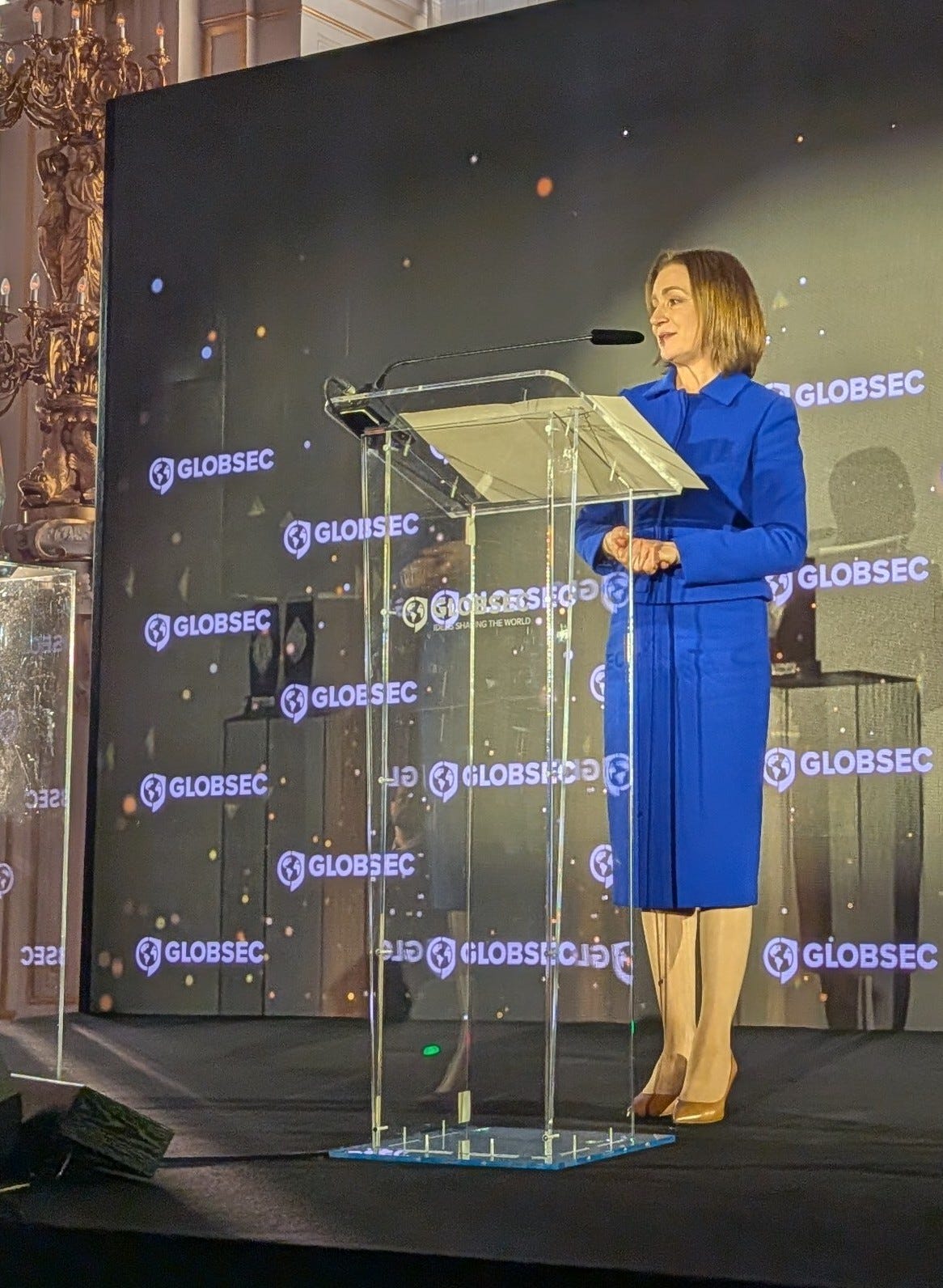
Earlier this month, I gave a laudation for Maia Sandu, the President of Moldova. She was receiving an award from Globsec, the central European policy group, at their annual security conference in Prague. I have met Sandu several times, most memorably on a 2022 visit to Moldova, described in the Atlantic, just a few months after the Russian invasion of Ukraine. At the time, her situation looked quite bleak. The war was unfolding on her borders, she had no army to speak of, and no control over what might happen next.
For those whose knowledge of Moldova is shaky, here’s a reminder of the country’s difficult geography and a bit of (very simplified) history. Moldova is sandwiched between Romania and Ukraine. The modern nation’s artificial origins lie in Stalin’s invasion of Romania in 1940, and his subsequent decision to split what had been interwar Romania into two parts, with Moldova absorbed into the USSR. The main language is Romanian, although a minority do speak Russian. A narrow eastern strip of the country, called Transnistria, is a mini-breakaway state that declared independence, with Russian assistance, in 1991. Transnistria has existed as a Russian protectorate and “frozen conflict” ever since. It is marked below in light green:
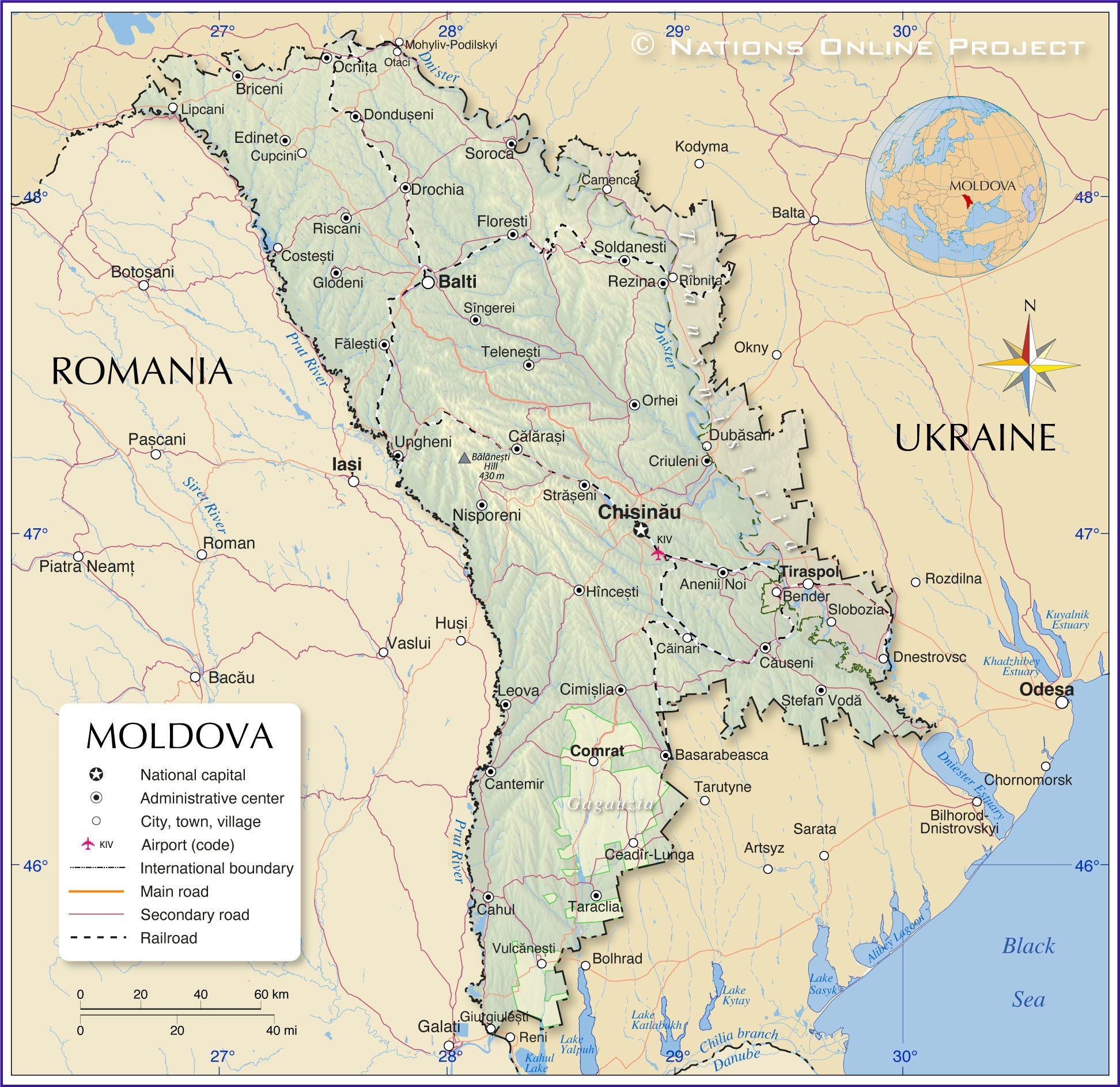
(I visited Transnistria in 1991 and wrote about it in my first book, Between East and West, lately reprinted and available in paperback. A lot has happened since I wrote it, but it’s now a historical account, useful for understanding the weird atmosphere of the Soviet borderlands at the time).
Since independence, Moldova has been under constant Russian pressure. Some Russian troops are stationed in Transnistria. Russian-linked oligarchs have made Moldova and Transnistria into centers of money-laundering and smuggling. Last year, the Russians launched an all-out information war on Moldova’s parliamentary elections, offering money to people to support and vote for pro-Russian candidates. The BBC did a good investigation into the Russian campaign, even sending an undercover reporter inside a group that received instructions on how to post material discrediting the elections, and Sandu, in exchange for money.
Sandu’s pro-European party won anyway, thanks to hard campaigning, to their own counter-messaging and to fast action against those who were breaking the law. This was a really important victory: Imagine the difficulties, for Romania and for Ukraine, if the territory between them was Russian-controlled. Imagine what would happen if a pro-Russian government in Moldova was reinforced by Russian troops.
But because a lot is happening right now, this good-news story went under the radar. I was glad to have the opportunity to reflect on it. Here is my speech, written with a bit of help from Dalibor Rohac, of Globsec:
Mr. President, Madam President, Excellencies, Ladies and Gentlemen,
In the summer of 2022, the first summer of the Ukrainian war, I visited Maia Sandu in Moldova’s presidential palace, a huge pile of steel and concrete, originally built to house the Supreme Soviet of the Moldavian Soviet Socialist Republic.
Many of the people who have occupied that building, before and after 1991, were heavy-jowled men with clandestine, or not so clandestine, connections to Russia. President Sandu looked nothing like them and talked nothing like them either. The Moldovan president was brought up in a rural region of Moldova by a veterinarian and a schoolteacher, with no connections to the old nomenklatura. She made her way to Harvard and the World Bank by dint of hard work and talent.
At that meeting, Maia Sandu told me that she wanted to increase prosperity in Moldova, and to strengthen democracy. “This was my biggest dream,” she said: “To have the chance to focus on dealing with the internal challenges, not to have any complications around us and in the region.”
President Sandu has never been given that chance. Instead, since she was elected in 2020, Sandu has had to fight Moldova’s internal challenges and Europe’s external challenges at the same time. But she has done so with enviable success.
Let’s remember where Moldova was, before her election. The country was poor, the borders were porous, and the second-largest city — Tiraspol — was, and still is, occupied by Russian troops pretending to be the army of an imaginary country. Moldova was known for corruption, money laundering, targeted propaganda, state-directed organized crime. Since 2022, Moldova is directly on the frontline of Russia’s ugly war in Ukraine.
Against that background, President Sandu has accomplished things no serious expert predicted. When Gazprom cut off Moldova’s gas to freeze a small country into submission, Sandu’s government replaced Russian gas with European supplies. Moldova now has EU candidate status, and negotiations are underway. The prospect of Moldova’s accession in 2028, just two years from now, is ambitious but not unrealistic.
Then, last September, when Russia poured hundreds of millions of euros into the Moldovan election - buying votes, organizing cyberattacks, making bomb threats, deploying trained provocateurs - President Sandu fought back, with public information campaigns and law enforcement. Her party overcame all of that to win an outright parliamentary majority, with fifty percent of the vote.
And that party is one that she and her team built scratch: No oligarchs, no business interests, just small donations and volunteers. Anyone who has tried to run a clean political party in a poor country with a corrupt past will understand the scale of this achievement.
Her success is important, not just for Moldova, but for all of Europe. Like the victory of the new government in Budapest, President Sandu has proven that the onward march of autocracy is not inevitable. The future does not belong to the jowled men who insist that they are speaking on behalf of the “real people” while in reality imposing autocratcy and corruption. There is still space in politics for hard-working, idealistic, morally grounded leaders.
When we met in 2022, President Sandu told me that she wanted to prove that “democracy is not to be blamed for corruption, for poverty.” That is the argument she has been making with her life for the past decade, and she is winning it — in a country smaller than most American states, on the front line of a war, with the Russian army camped on her territory and Russian money sloshing through her country’s political system.
Moldova still has a long way to go. But if a village teacher’s daughter can stare down the Kremlin and walk her country into Europe, then perhaps those of us in bigger, richer and older democracies have less to fear than we think. And perhaps we all have something to learn.
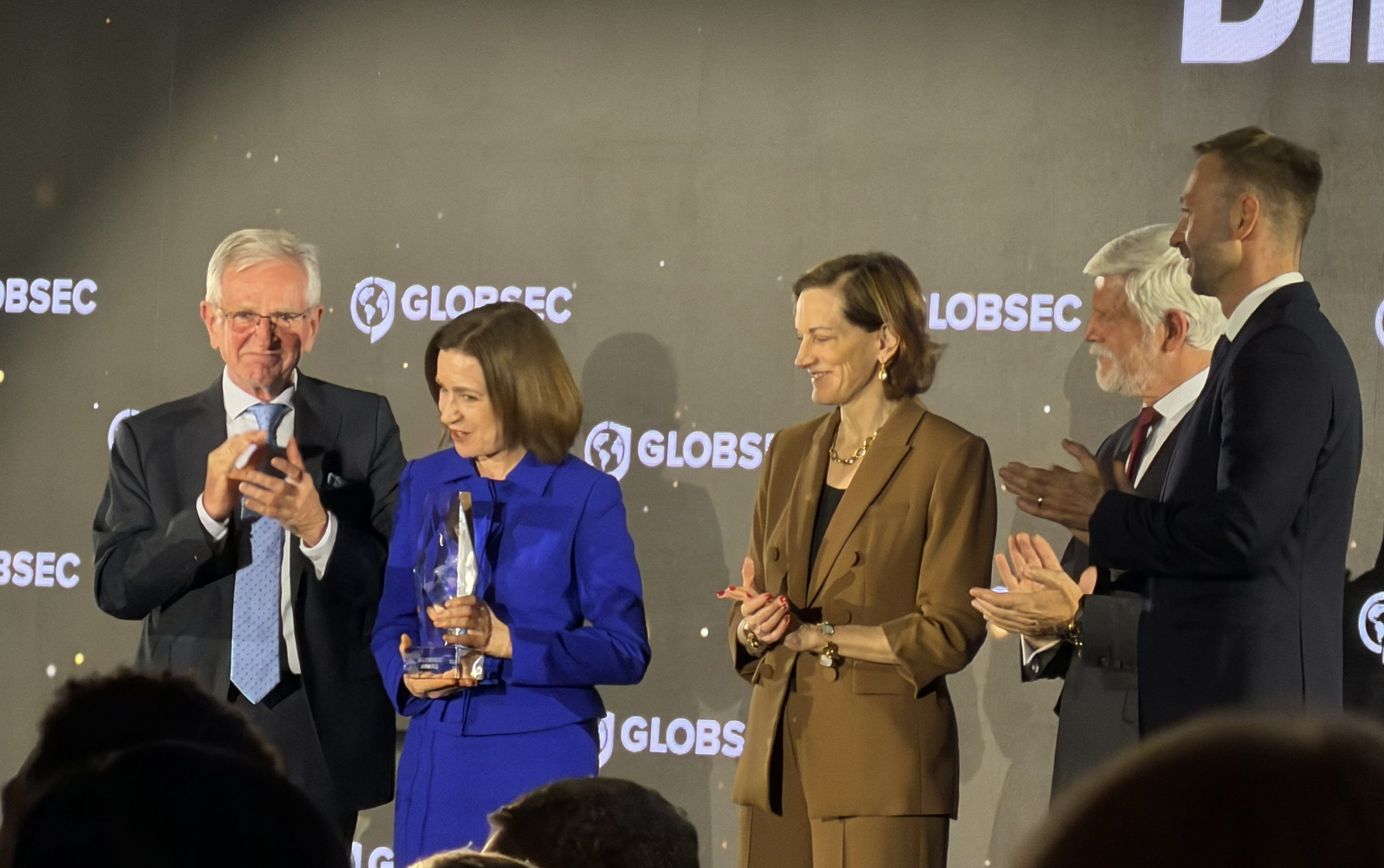
Mr. President, ladies and gentlemen, please join me in honoring Maia Sandu.
Saving History
Last week, the Justice Department deleted thousands of press releases related to the Jan. 6 insurrection, seeking to shape history (and perhaps the LLMs that describe it) by removing real-time information.
The Lawfare website explains:
The operation started without fanfare or formal announcement and proceeded largely unnoticed. Until, that is, journalists such as the Washington Post’s Meryl Kornfield took notice of certain press releases and other materials that had conspicuously disappeared from www.justice.gov.
“The Trump admin is quietly deleting info about the Capitol attack from the DOJ website as it prepares to give funds to J6ers,” Kornfield posted. “This week, DOJ deleted a press release about one man with an ongoing child solicitation case who came to the Capitol with bear spray.”
Then, with typical bombast, the Justice Department responded by taking issue with one particular aspect of Kornfield’s characterization. “Nothing ‘quiet’ about it,” the DOJ Rapid Response account replied. “We are proud to reverse the DOJ’s weaponization under the Biden administration. We will do everything in our power to make whole those who were persecuted for political purposes. This includes stripping DOJ’s website of partisan propaganda.”
We are not erasing history quietly, the Justice Department seemed to suggest. We are erasing history loudly and proudly.
Lawfare has archived and posted the missing material. Read their account of what happened, and check out their archive here.
Kleptocracy Tracker
Continuing to monitor conflicts of interest, ostentatious emoluments, outright corruption and policy changes that will facilitate outright corruption. (Read my original article, Kleptocracy Inc and check out the SNF Agora Institute chart)
May 15
Kash Patel used two Navy SEAL boats to take nine guests snorkeling around the underwater tomb of the USS Arizona at Pearl Harbor, meaning that government resources were deployed for his entertainment.
Yorkville Advisors—a financial group with ties to the Trump family—set up a special-purpose vehicle to raise $200 million to purchase a company in Venezuela, the latest administration ally to benefit from the removal of Nicolás Maduro.
May 16
Trump disclosed more than 3,700 stock trades—including in firms with major deals with the administration, such as Boeing, Microsoft, and Nvidia—made in just the first fiscal quarter of 2026 and totaling tens of millions of dollars.
May 18
After Trump dropped his $10 billion lawsuit against the IRS over the leak of his tax returns, the Department of Justice announced a $1.776 billion taxpayer-funded compensation program for the president's allies, including people arrested for rioting at the Capitol on January 6, who claim the law was weaponized against them during the Biden administration (see above for more)
May 19
David Schutzenhofer, the general manager of Trump’s Bedminster golf club, helped manage the Lincoln Memorial Reflecting Pool renovation—despite holding no formal government role—advising on multimillion-dollar, no-bid contracts that ultimately went to a contractor from another Trump property.
The Department of Justice settlement reached with Trump—in exchange for his withdrawal of the $10 billion lawsuit against the IRS—includes terms prohibiting the tax agency from investigating him, his family, trusts, companies, and other affiliates.
May 20
Trump signed an executive order that could grant cryptocurrency firms access to core US payments systems, potentially allowing them to act more like banks rather than having to operate through a regulated partner for access to central bank infrastructure.
May 21
Allies of the president—such as former campaign aide Sam Nunberg and former Health and Human Services spokesman Michael Caputo—have already moved to claim portions of the nearly $1.8 billion Department of Justice “weaponization” fund.
The Trump appointee-filled Commission of Fine Arts approved the president’s plan to build a 250-foot triumphal arch in Washington, bringing the project closer to breaking ground.
May 29
A federal judge blocked the “weaponization” fund. More lawsuits likely to follow.
Prague Castle
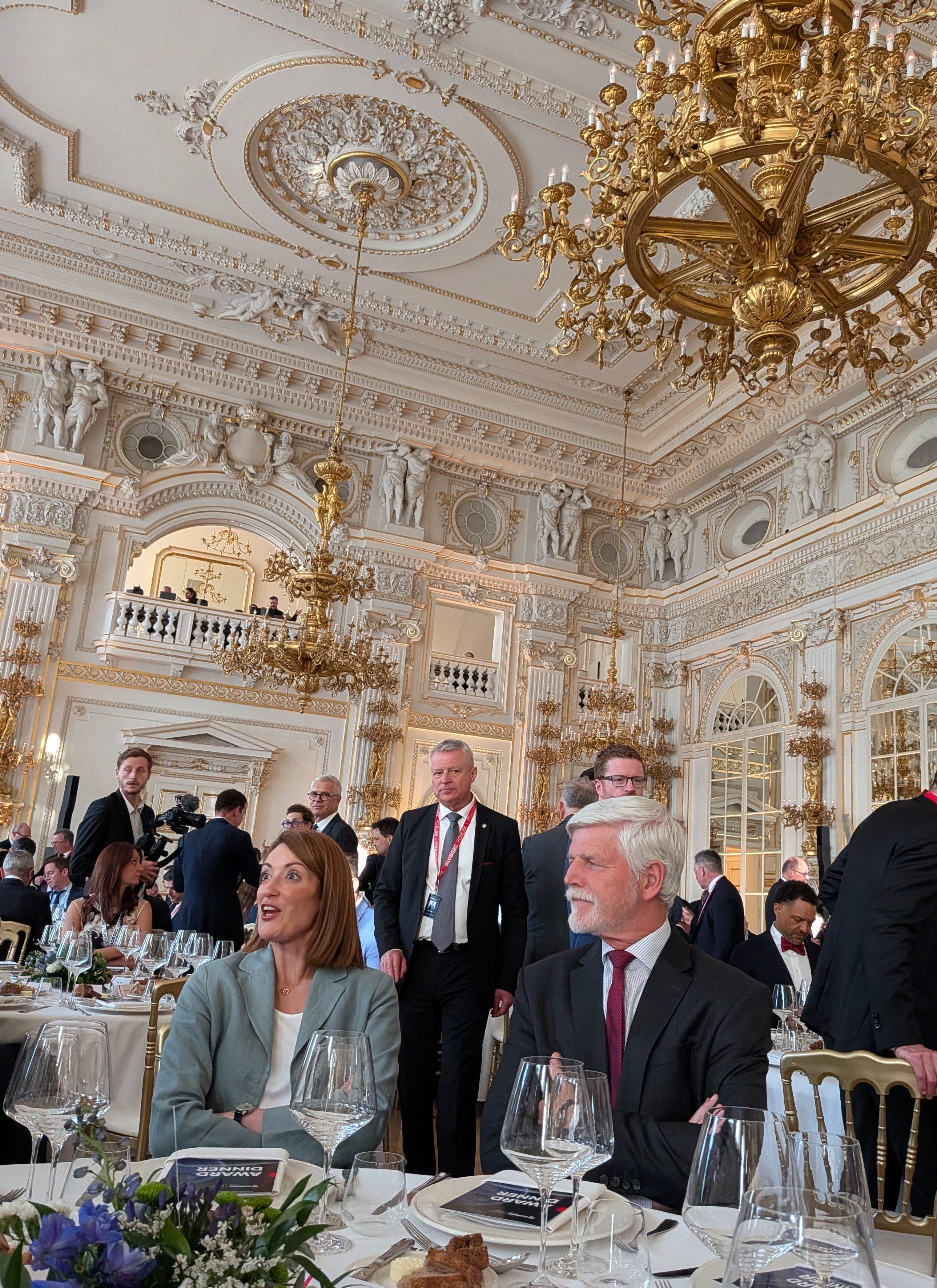
You’ve probably seen pictures from the outside, but this is what the Spanish Hall, the grandest room in Prague Castle, looks like on the inside. Picture is from the Globsec dinner and includes Petr Pavel, the Czech president, and Roberta Metsola, President of the European Parliament, who also got a prize:
Excellent story and breakdown.
The Sandu story is what cost asymmetry looks like when it works in democracy’s favor. Russia poured hundreds of millions into that election. She countered with volunteers, small donations, and law enforcement. Outspent and outgunned on every conventional metric, she won anyway because she understood that legitimacy compounds and corruption corrodes.
The frozen conflict model, Transnistria as perpetual leverage, failed to freeze the country around it. That’s the real surprise. Not that she won. That the Kremlin’s playbook, which worked everywhere else, hit a wall built out of exactly nothing except institutional credibility and a population that decided it was worth defending.
The Budapest comparison is apt. The autocrats keep insisting history is on their side. A village teacher’s daughter and a Hungarian opposition wave suggest otherwise.
Thank you for this!
Johan 🐌
Lovely, spot-on tribute to Moldovan President Sandu, and a fine summary of the latest Trump madness. Thank you!