
The Post-Reality Campaign
Viktor Orban is waging cognitive warfare on a new scale
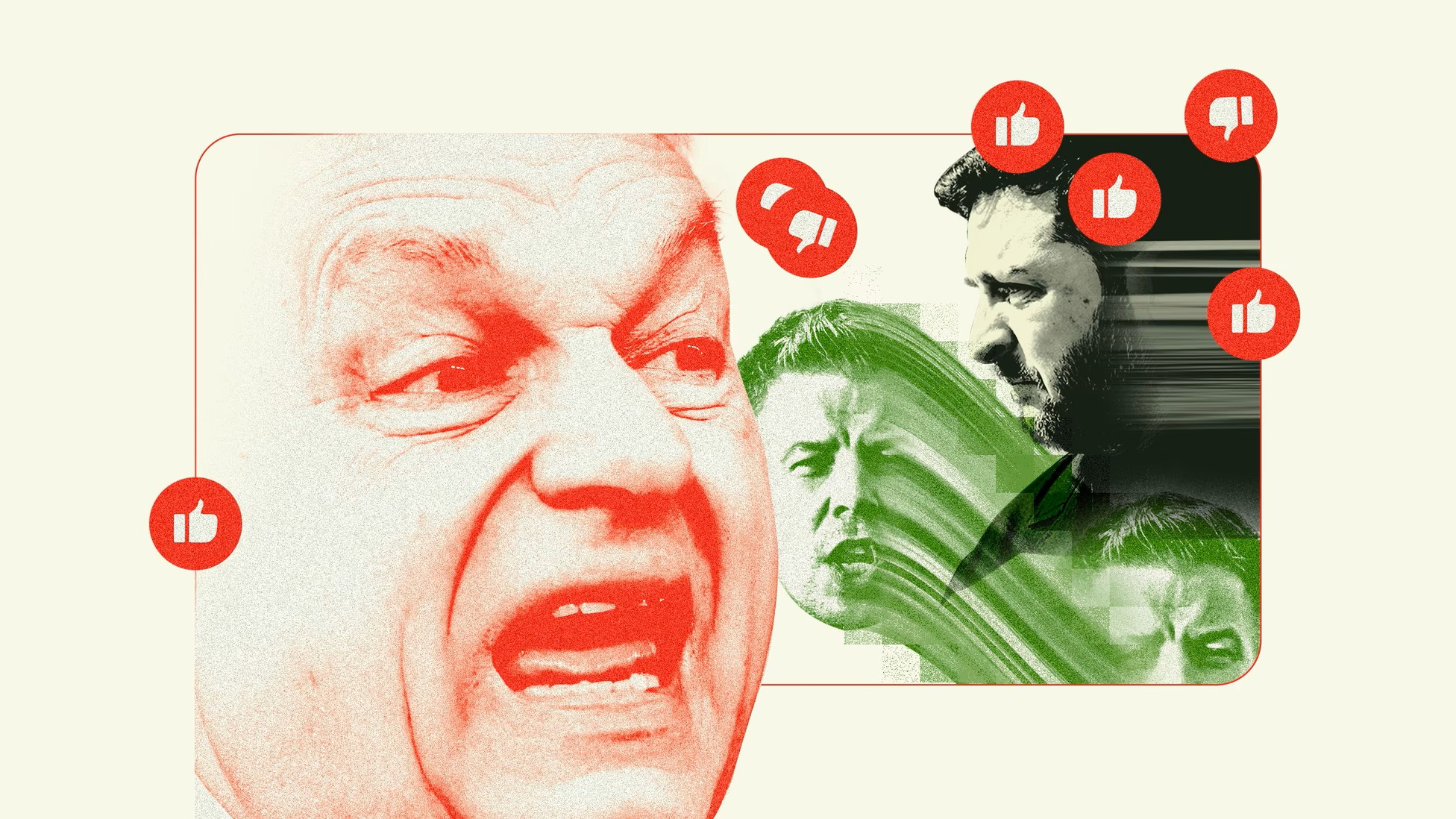
Hungarians who click on pro-government TikTok accounts might see an AI-generated version of Volodymyr Zelensky, the president of Ukraine, sitting on a golden toilet, counting his money, snorting cocaine, and barking orders at a Hungarian soldier. They might find an AI-generated Péter Magyar, the leader of the Hungarian opposition, appearing to say he’s fine with handing Hungarian factories over to foreigners, as long as he’s the one in charge of the country. They can also find graphic war scenes and a SpongeBob look-alike declaring that Magyar “wipes up cocaine with me after he accidentally sneezed and it all fell to the floor.”
But if they are looking at accounts that support the Hungarian government and its leader, Viktor Orbán, they won’t find much about Hungary at all. This is not an accident, as I wrote in the Atlantic (gift link):
After 16 years in office, plus an earlier three-year term, Orbán has made his country the most corrupt in the European Union, one of the poorest, and certainly the least free. His political party, Fidesz, now controls most universities, the civil service, the high courts, and, through a network of oligarchs, almost all newspapers and broadcasters, as well as about a fifth of the economy, according to independent economists. General paranoia about Fidesz spies means that Budapest, once again, has become a city where people lower their voices when talking about politics in public.
With that kind of influence, Fidesz, which is well behind in most polls, cannot evade responsibility for Hungarian stagnation, and so neither the party nor its leader is talking much about Hungary, its falling industrial production, or its shrinking population. Instead—backed by Russian propagandists, the European far right, and now the Trump administration (about which more in a minute)—the party is directing a small fortune’s worth of posters and social-media videos toward a different goal: convincing Hungarians to fear sabotage, thievery, or even a military attack from … Ukraine.
This is an entirely false, even ludicrous threat. The Ukrainians have enough to do without starting a second war in Hungary. But Orbán, his government, his party, and many outsiders are now focused on making this threat seem true. Pay attention, because this may be the future of electoral politics: Multiple politicians from several countries are shoveling propaganda at an electorate in order to build terror of an enemy that doesn’t exist at all.
It’s a form of cognitive warfare that even Hungarians tell me is unprecedented. In the past, Orbán has agitated to keep Hungary out of the war. Now he is telling people to be afraid of a Ukrainian invasion. During a Fidesz march on March 15, a group in the front of the crowd carried a banner declaring We won’t be a Ukrainian colony!
In Budapest, I saw a few of the Fidesz posters. On the right, the Ukrainian president is seen glowering alongside the slogan “Don’t let Zelensky have the last laugh.” On the left, you can see Zelensky with Magyar and Ursula von der Leyen, the president of the European commission, along with the slogan “They are the risk. Fidesz is the safe choice.”


The level of hysteria reflects the stakes:
Strange though it sounds, Hungary, although a tiny country in Central Europe, plays an outsize role in the imagination of the American and European far right: MAGA and its international wing understand that the Hungarian election, the most important in Europe this year, could mark a turning point in the war of ideas that has convulsed the democratic world for the past decade.
Orbán has been actively engaged in this battle, fighting against liberal democracy and the rule of law, advocating for authoritarian populism and one-party rule. He became a beacon for other leaders who seek to alter their own democratic political systems, who also want to twist the rules in order to ensure that they never lose. Kevin Roberts, the head of the Heritage Foundation, once said Orbán’s Hungary was not just “a model for modern statecraft, but the model.” Orbán pioneered a form of campaigning too, spending years convincing Hungarians that existential threats—from migrants, from so-called decadence, from the European Union—required the radical institutional changes that have kept his party in power. Americans will be familiar with these tactics, which have been adopted, and adapted, by Trump and Vance.
Orbán is also Russia’s most important agent of influence in Europe, and so the Russians are doing their best to help him:
Concerned that a key asset might lose power, the Russians have sent a team of propagandists to Budapest to ensure that Orbán wins. The Financial Times has identified the influence group as the Social Design Agency, a Kremlin-backed IT company whose activities are well known. In 2023, back when the American government was still interested in unmasking Russian propaganda, the State Department’s now-dismantled Global Engagement Center exposed the agency’s role in creating a series of seemingly native pro-Russian websites in Latin America. In Budapest, they were tasked with creating AI videos and using their existing network of trolls and bots to pass them on. One Russian network has circulated doctored screenshots of the English-language website Euronews, with fake quotes attributed to Magyar. The Washington Post investigation revealed that the Russians even proposed to stage a fake assassination of Orbán, in order to build more sympathy for him. They called this strategy “Gamechanger.”
The MAGA movement and its international wing are out in full force too:
Secretary of State Marco Rubio traveled to Budapest in February to endorse Orbán, even seeming to offer financial support “if you face things that threaten the stability of your country.” Vice President J. D. Vance is set to visit Budapest, probably after Easter. President Trump himself appeared on video at the Budapest meeting last Saturday of CPAC, the formerly mainstream-conservative organization that now organizes pop-up rallies on behalf of the international radical right. In his message, Trump offered his “complete and total endorsement” for Orbán, Russia’s closest European ally.
Other members of the European far right showed up in person. Alice Weidel, head of the far-right Alternative for Germany, made a speech attacking the European Union for allegedly sending billions of euros to Ukraine, “the most corrupt regime on Earth,” as if she were not speaking on a podium inside the most corrupt state in the EU, and were not echoing the rhetoric of Russia, which might authentically be the most corrupt regime on Earth. She was followed by Santiago Abascal, the leader of the Spanish far right, who said that Orbán’s Hungary—repressed and impoverished after years of ersatz populism—is a “shining beam of light in the darkness.” Marine Le Pen of France, Karol Nawrocki of Poland, and Geert Wilders of the Netherlands have also made appearances. Benjamin Netanyahu endorsed Orbán by video. Even the libertarian president of Argentina, Javier Milei, came all the way from South America to laud Orbán, a man who has built one of Europe’s most centralized and repressive societies.
To win, Orbán has to wage cognitive warfare on a totally new scale. Watch for the result, on April 12, and read the entire Atlantic article here.
Kleptocracy Tracker
Continuing to monitor conflicts of interest, ostentatious emoluments, outright corruption and policy changes that will facilitate outright corruption. (Read my original article, Kleptocracy Inc and check out the SNF Agora Institute chart)
March 20
DOGE staffers undercut the independence of the Nuclear Regulatory Commission—the bipartisan agency responsible for approving commercial nuclear power plants and monitoring their safety—in an effort to roll back regulations, providing financial benefits to nuclear energy companies, some of whom have important Silicon Valley investors.
March 23
The SEC’s top enforcement official clashed with superiors over the direction of the agency’s enforcement program—and its handling of cases tied to Trump and his family—before abruptly resigning just six months into her tenure.
Traders placed $580 million in bets in the oil market just minutes before Trump posted on social media claiming that productive talks with Iran had occurred, prompting a sharp decline in crude prices. (More on this below.)
March 24
Pentagon Chief Technology Officer Emil Michael—who led the effort to designate Anthropic a supply chain risk, a move that could tank the firm’s value—holds millions of dollars’ worth of stock in competitor Perplexity AI.
March 25
The Department of Justice agreed to pay Trump ally Michael Flynn $1.25 million to settle his wrongful prosecution lawsuit, which he brought after facing charges for lying to federal agents during their investigation into ties between the 2016 Trump campaign and Russia.
Trump tapped tech billionaires including Mark Zuckerberg, Larry Ellison, and Marc Andreessen to serve on the President’s Council of Advisors on Science and Technology, co-chaired by venture capitalist David Sacks. Several council members have donated millions of dollars to Trump’s campaigns or projects and have benefited from administration policies and decisions.
March 26
The US has bolstered Pakistan’s diplomatic profile following several private deals between Islamabad and White House allies, including the redevelopment of a Pakistan-owned Midtown Manhattan hotel and a memorandum of understanding between Pakistan’s Finance Ministry and World Liberty Financial.
The State Department reallocated $1.25 billion originally designated for international disaster relief and peacekeeping to Trump’s “Board of Peace,” over which he has complete discretion as chairman for life.
Kleptocracy Extra: There have never been more ways to insider trade
On March 23, about 15 minutes before Donald Trump posted a statement claiming he was engaged in “productive” talks with Iran, traders made bets worth half a billion dollars in the oil market. After his statment, the price of crude tumbled. Someone —perhaps administration officials and their families, or maybe close allies—made an enormous amount of money because they knew that statment was coming. This half-billion-dollar oil futures bet is part of a broader pattern in the Trump era: insiders placing extraordinarily well-timed trades that yield enormous, near-immediate windfalls.
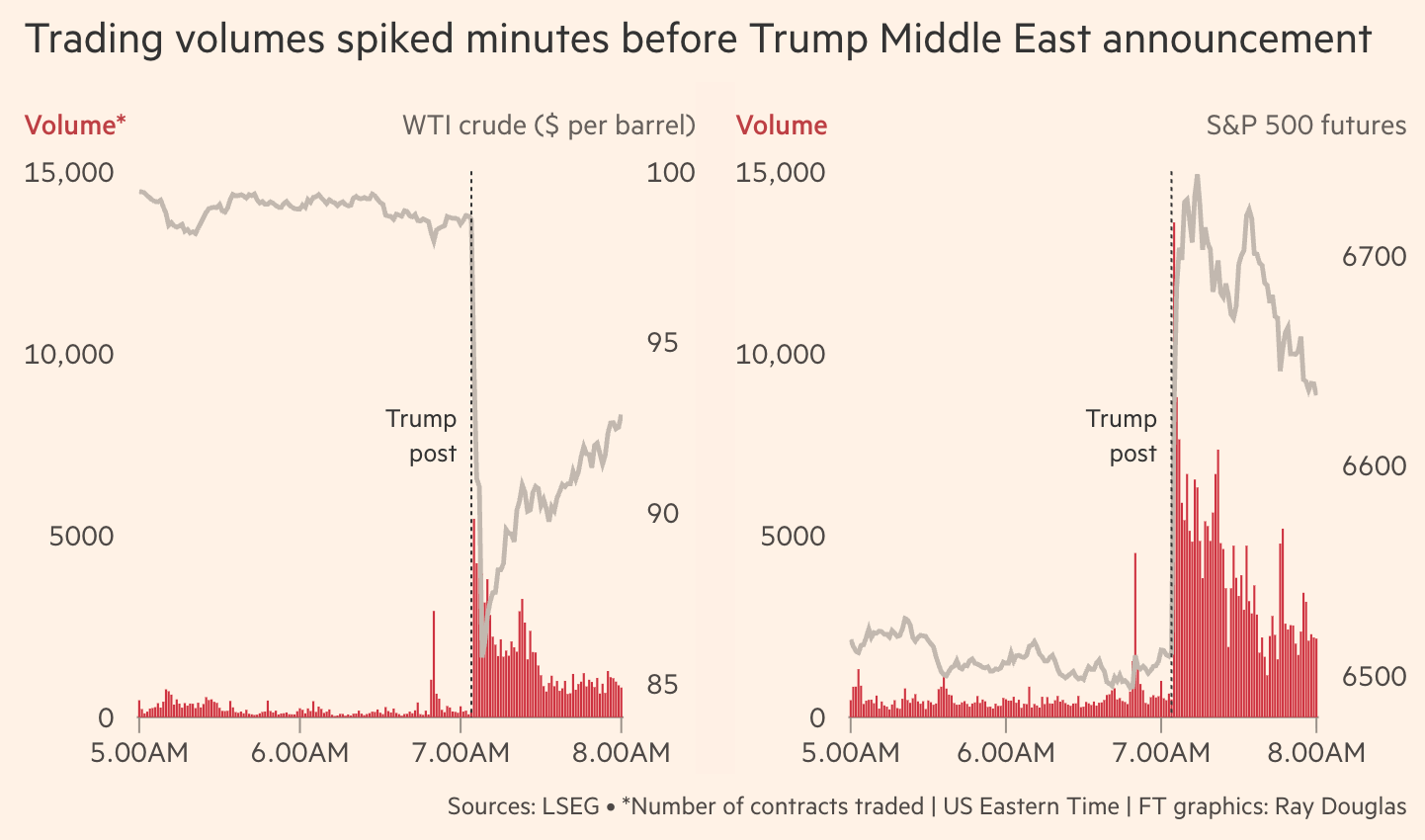
There are similar patterns in other markets. Someone purchased $1.5 billion in futures contracts just minutes before Trump’s announcement, which also triggered a spike in the S&P futures index. This trade was so large that it moved the index by more than 0.3% within a minute.
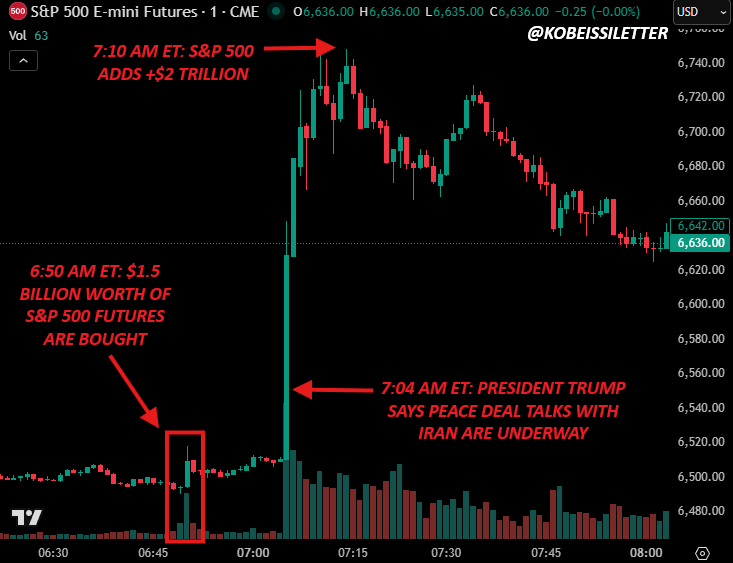
Usually, trades at this scale are made gradually, over an hour or more, in order to avoid moving the market—a phenomenon known as “slippage.” But this trader was confident that the bump to the S&P would exceed the slippage cause by the trade. Indeed, the index ultimately surged 2.5% following Trump’s Truth Social post.
Again, this is a pattern. In the days preceding Trump’s “Liberation Day” tariff announcement, which sent global markets reeling, more than a dozen high-ranking administration officials and congressional aides sold off securities. Former congresswoman Marjorie Taylor Greene purchased up to $315,000 in stocks during the ensuing market dip, just before Trump announced a pause on most of the tariffs, triggering a market rally.
Prediction markets are even more clearly moved by insider information. The Wall Street Journal reports that several Polymarket accounts made $1.2 million on February 28 from well-timed wagers on a US strike on Iran. One of those accounts also made a very profitable bet on US strikes just ahead of the Iranian nuclear facilities bombing last June. In the weeks before the January 3 US military operation that ousted Nicolas Maduro, one suspected insider placed $34,000 bets which netted more than $400,000.
This is the purest possible form of corruption: American officials are using American policy not to benefit Americans, but to make money, for themselves or their friends. As my colleague Charlie Warzel has written, prediction markets such as Kalshi and Polymarket have ushered in a moment when anyone with access to exclusive information can make a fortune. Perhaps information is already being shaped for that purpose.
The Sistine Chapel
and the Vatican, by night. They were getting ready for Easter.



Orbán’s post-reality campaign isn’t new in kind, just in scale.
Authoritarian regimes have always manufactured threats to justify power consolidation. What’s different now is AI-generated content makes the fabrication cheaper, faster, and harder to debunk before it spreads.
The tell is the inversion, Hungary isn’t at war, Ukraine is. Ukraine isn’t invading anyone, Russia is invading Ukraine. But Orbán needs Hungarians terrified of a Ukrainian threat that doesn’t exist so they’ll accept his alignment with the actual aggressor. AI Zelensky on a golden toilet snorting cocaine does more work than a thousand rational arguments, because it bypasses System 2 entirely and triggers disgust, fear, resentment at the gut level.
By the time someone fact-checks, the emotional imprint is already locked in.
Thank you for writing this, This is cognitive warfare at industrial scale. April 12 will show whether manufacturing reality works better than documenting it.
Ciao,
Johan
Control of the internet and social media have become the iron web of fascist state manipulation. We can now also easily see how the Fascist Brotherhood comes together to protect its own. Never has it been more important to have an intellect not easily hoodwinked or discouraged. This is a never ending battle for freedom and we must reconcile ourselves to that dreary fact.