
Ukraine is Not Losing
And for Russia, that's a huge defeat
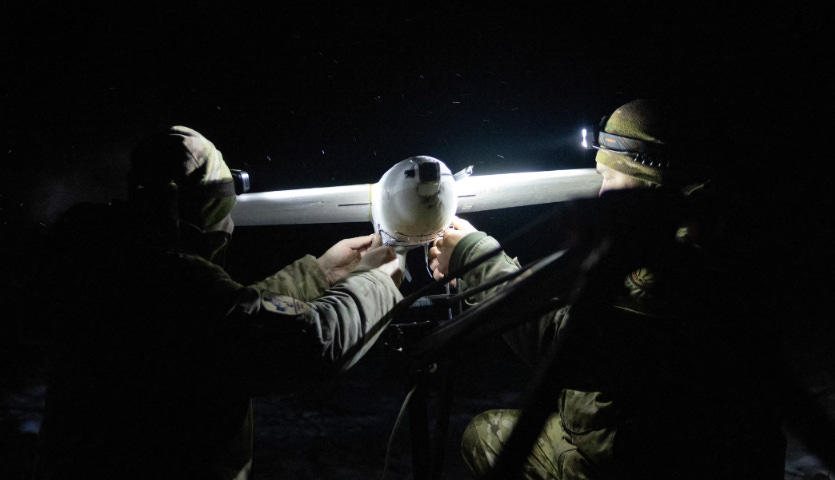
Last week I went to Kyiv to attend a security conference, meet friends and also take some time, as I have done in the past, to learn more about the tools the Ukrainians are creating to fight the war (see here for my article about long-range drones, and here for sea drones). This time, I went to see one of the teams who operate drone interceptors, the small defense drones that can knock out attack drones. This is a technology that everyone suddenly needs, not just in Europe but in the Gulf States as well:
In a field outside of Kyiv last weekend, a van was parked discreetly behind some trees. Inside the van there were no passenger seats, just a long desk, two office chairs, two laptops, extra screens. Outside appearances to the contrary, this was a mobile drone-interceptor base, one of hundreds of similar vehicles now scattered around Ukraine. It’s also part of something much bigger: a set of technological advances that have changed the war with Russia, and maybe all wars, forever.
On one of the laptops, a soldier showed me a bird’s-eye view of a part of the Ukrainian countryside more than 100 miles away. His job is to identify the objects flying above it, to distinguish birds and bats from lethal Russian drones. When he sees the latter, the soldier on the laptop beside him can then direct an interceptor—a small drone that looks like a miniature rocket ship—to track and destroy the incoming Russian aerial vehicles before they hit their targets.
At first glance, the images on the screens look simple, like a video game. But this is not a low-tech operation. The AI-powered drone interceptors are made possible by a complicated network of radar systems, acoustic sensors, and other tools that hundreds of large and small Ukrainian tech companies are creating and updating every day, using data they get directly from soldiers like the ones I met. Almost none of these companies existed four years ago. They have emerged from a tech-literate civil society whose members changed their professions or their focus to help defend their country. I have met Ukrainian defense-company CEOs who come from financial services, architecture, politics. I met another one last weekend who had returned just that day from the front line. He told me he finds it useful to learn how soldiers are using his products, and how they might be improved.
Other kinds of teams across the country are connected to this constantly improving information system too, and not just in vans. Last year I was in an underground room in Ukraine where dozens of people were monitoring hundreds of miles of the front line on a series of screens. The Ukrainian defense analyst Andriy Zagorodnyuk calls this system of drones, monitors, AI-powered navigation, battle-tested robots, and interconnected soldiers “networked situational awareness,” and it explains why perceptions of this war have suddenly changed.
The drone interceptors are part of the explanation for a sudden, notable change in international perceptions of Ukraine.
Since 2022, many public arguments about the war, even in Europe and the U.S., have adopted the narrative put out by Russian propaganda, tacitly assuming that Ukraine, outmanned and outgunned, would eventually lose. Helping Ukraine was a way to stave off disaster, nothing more. When the Trump administration stopped sending military and financial aid to Kyiv in 2025, some in Washington expected (and maybe wanted) the end to come quickly.
Instead, Europeans have provided money. Ukrainian society produced networked situational awareness. And when Ukrainian President Volodymyr Zelensky toured the Gulf states in late March and signed a series of security agreements, something changed in the international narrative. The leaders of Qatar, the United Arab Emirates, and Saudi Arabia were talking to Ukraine, not because they felt sorry for a war victim, but because they wanted to acquire drone interceptors like the ones I saw in action last weekend. Iranians use the same drone technology as the Russians, and the Ukrainians know better than anyone how to fight it.
Look carefully at the three most important theaters of the war. After more than four years of fighting, Russia is not winning any of them:
The ground war. If the story of the past two years was one of slow, grinding forward progress for Russia,the story of this year is very different. Since early spring, at the start of its annual offensive, Russia has lost more territory in Ukraine than it has gained. Right now, it is hard to see how the Russian army can move forward, because the front line is not a line at all, but rather a broad no-go zone, some 20 miles wide. Everything inside this zone is visible to drones, which means that any Russian truck, tank, or infantryman seeking to attack new territory is instantly identified and can easily be hit. Because the Russian commanders keep attacking anyway, the Ukrainians are killing and wounding thousands of enemy soldiers, perhaps as many as 30,000, every month. They say their goal is to remove more Russians from the battlefield than can be recruited to replace them, and they may be close to succeeding.
The long-range war. Although they are unable to move the front line, Russians can still use drones and missiles to kill civilians and destroy civilian infrastructure in Ukrainian cities, as they did once again this week. Indeed, Russian President Vladimir Putin’s appetite for this kind of attack is escalating, as he has no other practical way to damage Ukraine. He also knows that the Ukrainians don’t have enough air defense to stop ballistic missiles, even if they can now stop the majority of drones. Ukraine still relies heavily on air-defense equipment from the United States, especially ammunition for Patriot batteries. A European fund was set up to purchase these interceptor missiles, although some observers fear that there are simply not enough to buy. According to Zelensky, more Patriots were used during the first three days of the U.S.-Iran conflict than have been used during the entire Russia-Ukraine war.
What Putin doesn’t acknowledge is that his side is running out of air defense, too. That has helped Ukraine’s long-range drones more reliably target Russian oil and gas infrastructure, producing spectacular explosions and reducing Russian refining capacity by at least 20 percent. Almost all major oil refineries in central Russia have halted or scaled back production, and some have been hit more than once.
With equal regularity, a new crop of Ukrainian drones with a range of 100 miles can target arms depots, logistical centers, and supply chains far behind the front line in Russian-occupied territories. These strikes are less spectacular than ones deep inside Russia, but they have already created crucial fuel shortages on the Crimean peninsula, and they are making it difficult for the Russians to supply their troops fighting in the East and the South.
The psychological war. For the past four years, the Kremlin has repeatedly told the Russian public that the war is going well, that Ukraine isn’t a real country, that victory is certain. But that’s hard to square with the panic that took hold of Moscow last month, when an annual military parade was shortened for fear it would be interrupted by Ukrainian drones. Nor does it square with the spectacular columns of black smoke that were billowing into the air on Wednesday morning, after Ukrainian drones hit a local refinery on the opening day of the Kremlin’s annual St. Petersburg economic forum. Kyrill Budanov, the former defense-intelligence chief who is now head of the Ukrainian president’s office, told me there is a lot of evidence that Russians are now finally facing the up to the falsehood of state propaganda: “They cannot understand why they have to keep fighting and why they are getting hit now, because they were told they were going to win and Ukraine is nothing.”
This doesn’t mean that the war will end soon. This past week, Zelensky again offered Putin a ceasefire on the current lines, which, again, he refused to accept. As I have been writing since 2002, the war will end when Putin gives up his central aim: the destruction and subjugation of Ukraine, the removal of Ukraine from the map of Europe. Some in Moscow are already pushing him in this direction. All of the evidence shows that Russians are tired of the war, the Russian elite wants to end the wa, which is why some in Kyiv are still hoping that negotiations will produce a ceasefire later this year.
Even without negotiations, the war may be heading in a new direction.
The transparent frontline zone may now be 20 miles wide, but as drone technology improves, it could soon be 30 or even 40 miles wide. At some point the front line will become not just a no-man’s-land but a de facto demilitarized zone, similar to the one that separates North and South Korea, regularly patrolled and maintained by drones.
After that, it could become a border—a temporary border, one that will not be recognized by either side—but a border nevertheless: no different from a river or mountain range, impossible to move, difficult to cross. This would not be a clear victory for Ukraine, but it would be a major defeat for Putin, whose central goal—the destruction of all of Ukraine, the removal of Ukraine from the map—would never be realized.
read the whole article here (gift link)
Kleptocracy Tracker
Continuing to monitor conflicts of interest, ostentatious emoluments, outright corruption and policy changes that will facilitate outright corruption. (Read my original article, Kleptocracy Inc and check out the SNF Agora Institute chart)
May 26
Trump repeatedly promoted Stake, an unregulated online casino operating illegally, on Truth Social after its co-founder donated $1 million to Trump’s super PAC, MAGA Inc. In its way, this story, which has received little attention, is the epitome of this administration’s corruption: you can simply pay the president to promote your company, however dodgy.
May 27
The Trump administration is pursuing funding deals with several drone companies, including Unusual Machines—a drone components supplier in which Donald Trump Jr. is both a shareholder and advisory board member.
A National Park Service analysis found that the Trump administration’s no-bid contract for repairs to the Reflecting Pool approved an inflated profit margin of 20%—far higher than the typical 6–12%.
May 28
Trump purchased more than $1 million worth of stock in Dell earlier this year, before the company received a $9.7 billion Pentagon contract this week. The contract was also preceded by founder Michael Dell’s early engagement with the administration—including a $6.25 billion gift of Trump Accounts for 25 million American children—followed by White House support that contributed to the company’s best month on Wall Street since its return to the public market in 2018.
The Commodity Futures Trading Commission asked a judge to vacate a $5 million penalty imposed, at the end of the Biden administration, on a cryptocurrency exchange run by Trump donors Tyler and Cameron Winklevoss.
The Department of the Treasury has prepared to print $250 bills bearing Trump’s face—the latest in a series of attempts by the administration to use government resources to pay tribute to the president.
White House adviser Peter Navarro asked the Department of Defense to approve a $620 million loan for a rare-earth magnet company in which Donald Trump Jr. holds a stake.
Trump refiled his defamation suit against the Wall Street Journal over its reporting on his birthday letter to Jeffrey Epstein, continuing his effort to extract $10 billion from the newspaper.
May 29
The Pentagon awarded SpaceX two contracts totaling $6.45 billion ahead of the company's upcoming IPO, potentially boosting its valuation—and the financial interests of 10 Trump officials with vested stakes in the firm, including Steve Witkoff.
June 2
After the presiding judge raised questions about the agreement, the SEC defended its $1.5 billion settlement with Elon Musk over his failure to properly disclose when his stake in Twitter surpassed 5% before he acquired the company—a lapse that may have allowed him to underpay for his shares by more than $150 million.
June 3
The Trump administration has awarded another no-bid contract for a cosmetic Washington, DC project—this time to Gilders’ Studio for gilding statues near the National Mall at a cost of $5.1 million, more than double the $2.4 million the Park Service estimated the project would cost in March.
A nonprofit founded by Trump donors has raised $36 million to provide legal assistance to allies of the president who claim they were unjustly prosecuted by the government.
Kyiv, an ordinary city
I was in Kyiv on Monday, June 1. That evening the city was hit by another series of drone and missile attacks. Readers may have seen photographs of the destruction. But it’s important to remember that Kyiv is also a normal city. Bars, restaurants, and shops are open. Traffic flows. People continue to live their lives, as they should: The war is now in its fifth year, and no one can put everything on hold for that long.


Extremely important observations and not just about drones. It’s buried near the end: the front line may be evolving into a de facto demilitarized zone…not a ceasefire, not a peace treaty, but a technological fact. A geography of permanent mutual deterrence enforced by autonomous systems rather than political agreement.
This matters enormously. What Ukraine has built isn’t just a battlefield innovation. It’s a proof of concept for a new kind of territorial sovereignty. You don’t need NATO membership or a UN Security Council guarantee if you can make every square kilometer of contested ground too costly to cross.
Sovereignty, historically a legal and political construct, is becoming an engineering problem.
The Foreign Service lens here is clarifying. What we’re watching is the decoupling of security from alliance. For decades, the international order ran on the implicit logic that small states needed great power patrons. Ukraine—-abandoned by Washington, armed and adapted largely by its own civil society and European partners, is demonstrating that a sufficiently mobilized tech-literate society can manufacture its own deterrence. That’s a seismic shift in the structural logic of the state system.
Complications:
First, the Patriot missile constraint is serious. More Patriots were used in three days of U.S.-Iran conflict than Ukraine has used since 2022; that asymmetry has compounding effects on Ukraine’s ability to defend population centers while prosecuting the long-range war. The drone war Ukraine is winning and the missile war Ukraine is still absorbing are two different conflicts running simultaneously.
Second, the Gulf pivot is more significant than it reads. When Qatar, the UAE, and Saudi Arabia engage Zelensky not as a sympathetic victim but as a defense technology vendor, the entire frame of the conflict shifts. Ukraine is no longer the object of geopolitical charity. It’s a node in a new security market. That’s durable power.
Putin’s core bet in 2022 was that Ukraine wasn’t real. That it is not a nation, not a fighting force, not a society. Four years later, Ukraine is exporting its war technology to the Gulf. The bet has failed. The only question now is how long it takes Moscow’s elite to find an exit that doesn’t require admitting that plainly.
🐌Johan
Thank you Anne. We need encouraging new about what we are facing here also. I am sure MBS and his money people were very aware of the smoke rising in St. Petersburg. They are now very appreciative of Zelinsky's offer or anti drone technolgy.